


Engineering an Enterprise Student Application Portal, AI Agent Extraction, and Integrated QuickBase Ecosystem
Streamlining the Student Applications Process with Agentic HubSpot Implementation
The University of Medicine and Health Services (UMHS) is a premier offshore medical school dedicated to preparing personalized, highly trained physicians for licensure and practice in the United States and Canada. UMHS operates a rigorous academic program supported by personalized student support services and state-of-the-art facilities. Operating in an increasingly competitive higher education landscape, UMHS processes high volumes of complex medical school applications—including AMCAS, AACOMAS, and OMSAS packages—demanding extreme data precision, secure handling of official transcripts, and seamless cross-departmental handoffs from admissions to financial aid.
Technical Debt, Manual Bottlenecks, and Systems Fragmentation
Before partnering with Instrumental, UMHS relied on WebAdMIT and fragmented manual procedures to capture, evaluate, and transfer applicant data. This architecture introduced significant platform complexity and administrative friction:
-
WebAdMIT Limitations: Manual intake and processing within WebAdMIT created operational bottlenecks, slowing time-to-interview and straining admissions staff who spent hours re-keying data.
- Document Retrieval Silos: Official transcripts and Letters of Recommendation (LORs) arrived across multiple channels—Parchment, National Student Clearinghouse (NSC), Interfolio, and dedicated email inboxes. NSC and Parchment links frequently expired due to single-use, recipient-specific security gates, while staff manually parsed and filed every incoming document.
- Manual Record Creation: Admissions teams had to manually copy 30-to-60 page application documents—including academic histories, multiple MCAT sittings, and lengthy personal statements—into internal systems.
- Downstream Data Friction: Financial Aid and Bursar teams relied directly on a single QuickBase "IA" table containing roughly 1,000 fields. Decoupling from WebAdMIT required a seamless, automated bridge from HubSpot to QuickBase to prevent operational downtime.
Native HubSpot Portal & CRM Architecture
- Custom Application Architecture: Configured custom Application Deal pipelines, mapped custom objects, and built custom cards/tabs to support internal committee review and decisioning.
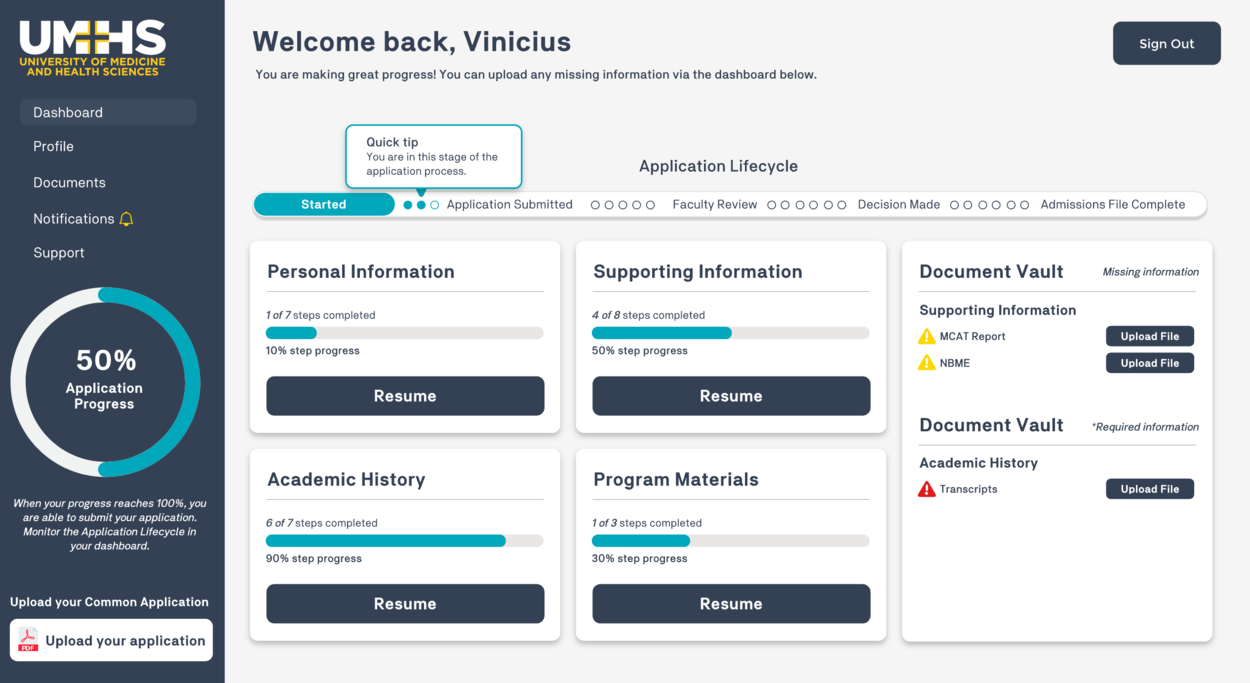
- Mobile-First Student Application Portal: Built a password-authenticated, multi-step application experience on HubSpot CMS Enterprise featuring step-level validation, automatic progress saving across devices, and dynamic field pre-filling for re-applicants.
- Internal Voting & Review Module: Built an isolated committee voting card inside the Application record with single-vote enforcement, role-based visibility (reviewers see only their votes; the Chairperson sees all votes and notes), and decision locking.
- Automated PDF Consolidation: Engineered automated triggers to generate a single consolidated PDF combining all application responses and attached supporting documents upon student enrollment.
- Recommendation Request Workflows: Built automated recommender workflows that issue secure upload links to external recommenders and log real-time submission status back to the applicant dashboard.
AI Document Extraction & Railway Integration Middleware
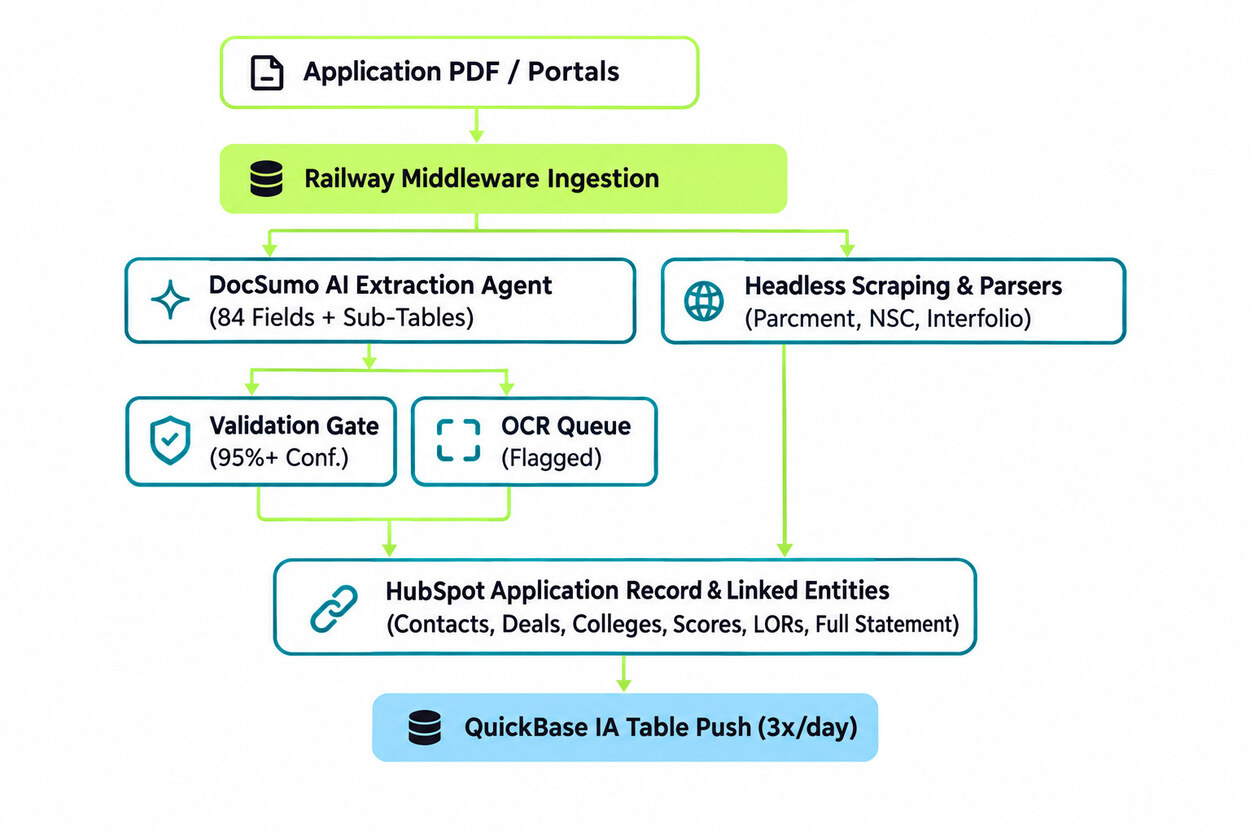
DocSumo AI Extraction Agent: Deployed an AI extraction agent running against a proprietary schema. The agent processes 30-to-60 page AMCAS, AACOMAS, and OMSAS PDFs without manual intervention, extracting 84 applicant fields and three variable-length tables:
-
Colleges & Degrees: Individual linked records for each school attended, attendance dates, term systems, primary flags, and earned degrees.
- Standardized Test Scores: Per-sitting records for MCAT, IELTS, and TOEFL (capturing all section scores, totals, and AAMC IDs), plus catch-all entries for GRE and AAMC PREview.
- Languages & Personal Statements: Extraction and normalization of native/additional languages and complete, un-truncated personal statements exceeding 5,000 characters across page breaks.
Data Normalization & Human-in-the-Loop Safeguards: Normalized inputs during extraction (e.g., "Georgia" to GA; consistent phone/date formatting) while preserving raw text in companion fields when dropdown options mismatched. Automated routing sends records to an OCR Review Queue if required identity fields are missing, content is altered/illegible, or confidence scores fall below threshold.
Automated Document Retrieval Engine: Engineered custom Railway middleware connectors:
-
Parchment & Direct Attachments: Automatically matched incoming transcript PDFs and attached them directly to Contact/Application records.
- Headless Scraping for NSC, Parchment, MyEquals & MyCreds: Built headless browser workers running continuously to bypass single-use consent screens and retrieve transcripts before download links expire.
- Interfolio & Email Ingestion: Automatically parsed incoming LOR emails, extracted applicant identifiers, deduplicated files by key, and attached PDFs to HubSpot records.
HubSpot-to-QuickBase Automated Sync: Constructed a Node.js middleware app deployed on Railway. Flattened HubSpot’s multi-object schema (Contact + Deal + Sub-records) into QuickBase’s flat IA table across ~1,000 fields, executing automated updates 3x daily with per-record audit logging and admin alerts.
The Results: Operational Velocity, AI Precision, and Zero Data Friction
Replacing WebAdMIT with a custom-engineered HubSpot ecosystem transformed UMHS admissions operations:
- Zero-Touch Processing Velocity: Clean 30-to-60 page applications are fully parsed, validated, and created in HubSpot as structured records within 2 to 5 minutes—completely eliminating manual data entry.
- Elimination of Administrative Bottlenecks: Automated headless browser retrieval and email parsing completely removed the manual overhead of logging into third-party transcript portals and manually filing LORs.
- 100% Data Completeness Enforcement: Built-in system gates prevent staff from seeing partially written records; applications are set to "Complete" only after every sub-record, test score, and linked college is saved.
- Flawless Downstream Continuity: Financial Aid and Bursar teams continue operating out of QuickBase without interruption, receiving synchronized, audit-logged applicant data three times daily
Driving efficiency through agentic operationalization
Driven by a Human-Led, AI-Accelerated philosophy, Instrumental leveraged AI as an operational multiplier across the strategy, design, development, and launch phases to execute at pioneer speed without compromising enterprise rigor. During strategy and technical discovery, internal AI frameworks were deployed to rapidly analyze complex, legacy data schemas—synthesizing over 1,000 QuickBase fields, AMCAS/AACOMAS/OMSAS application structures, and multi-channel transcript ingestion patterns into clean, actionable architectural requirements.
Throughout the design and development phases, AI-assisted development tools sped up the generation, validation, and testing of custom Node.js middleware scripts for Railway, error-handling routines, and API endpoints, allowing the engineering team to iterate rapidly on complex data transformations. For go-live preparation and change management, Instrumental utilized AI to generate comprehensive technical documentation, edge-case testing scenarios, and structured team enablement materials. By taking an "Outcomes Over Outputs" approach, Instrumental used AI internally to absorb heavy technical uplift, compress a multi-system implementation timeline, and de-risk deployment—delivering UMHS an enterprise-grade ecosystem faster, more efficiently, and with total clarity
Pioneer-Backed Scalability and System Stability
By replacing rigid legacy infrastructure with native HubSpot tools, custom Railway middleware, and AI extraction, UMHS established an agile operational foundation built for long-term growth.
To ensure continuous system performance and platform health, UMHS transitioned into Instrumental’s dedicated Support & Administration program. Centered on both people and systems stability, this phase provides:
- People & Learning Alignment: Structured change management, monthly strategic consultation meetings, user provisioning, and AI/copilot activation training to empower admissions and administrative staff.
- Systems Stability & Health: Continuous HTTPS/TSL checks, Google Search Console coverage monitoring, Core Web Vitals optimization, SLA-backed bug resolution, ticket support, and ongoing API/integration maintenance across HubSpot, Railway, and QuickBase.
With automated intake running unattended and downstream systems perfectly synced, UMHS can focus on delivering premium service to prospective medical students, parents, and alumni across the globe.